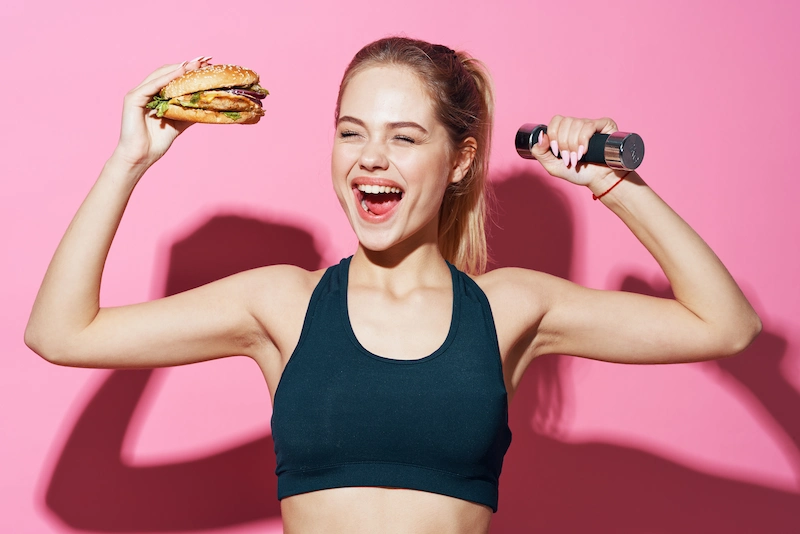
Yes, lifting heavy weights will make your arms bigger. Your arms grow through muscle hypertrophy, and heavy resistance training creates the stimulus your muscles need to repair and rebuild larger.
What makes muscles grow bigger
Muscle grows through a process called hypertrophy. When you lift weights, you create microscopic damage to muscle fibers, and your body repairs them and builds them back stronger and bigger.
Your body burns calories to digest food, and protein requires the most energy. Studies show going from a low protein to a high protein diet can raise your daily calorie burn by about 4 to 5%. Protein has a thermic effect of 20 to 30%, which is more than double any other food.
For muscle growth, you need 0.8 to 1 gram of protein per pound of body weight per day. If you weigh 200 pounds, aim for 160 to 200 grams of protein daily.
9 Steps To Shed 5–10kg in 6 Weeks
In only 90 minutes a week!
Includes an exercise plan, nutrition plan, and 20+ tips and tricks.
Without dead boring diets that are like watching paint dry
Without getting results at a snails pace
How heavy should you lift
Heavy lifting means using weights that challenge your muscles within 5 to 30 reps. Research shows you can build muscle across this entire rep range, as long as you push hard and train close to failure.
For maximum strength and size, focus on 4 to 8 reps with heavier weights. For muscle building with less joint stress, 8 to 12 reps works well. You can even build muscle with lighter weights and higher reps up to 30, but you must push each set hard.
The weight should feel challenging. If you can easily do 12 reps when you planned for 8, add more weight. On your last rep, you should struggle to complete it with good form.
Which exercises build bigger arms
The best exercises target both your biceps and triceps. Your triceps make up about two-thirds of your arm mass, so you need to train them just as hard as your biceps.
For biceps, barbell curls are the foundation. Focus on lifting straight up with your wrists and hands toward the sky. Take your forearms out of the movement. Lower the weight slowly over at least 3 seconds, keeping tension the entire time. You can cheat the rep up if you’re tired, but always lower slowly.
For triceps, lying triceps extensions work best. Angle your arms back 30 degrees, lock that position, bend your elbows, and lower the bar behind your head. This stretches the long head of the triceps. For heavier reps, use a slight pullover to cheat the weight up, then lower with a heavy negative.
Weighted dips also build triceps effectively. Set your posture before dipping by lifting your sternum and pulling your shoulders down. At the bottom, get a deep chest stretch. On the way up, squeeze your hands toward each other.
How often should you train arms
Train your arms 2 to 3 times per week with at least one rest day between sessions. Your muscles need time to recover and grow.
Each arm workout should include 3 to 4 exercises total, split between biceps and triceps. Aim for 3 to 4 sets per exercise. This gives you about 10 to 16 total sets per muscle group per week, which research shows is the sweet spot for muscle growth.
Training your arms every day prevents recovery and limits growth. Your muscles grow during rest, not during the workout itself.
How much muscle can you gain
Beginners can add 5 to 10 pounds to their lifts every week, especially on major movements. If you’re new to training, you could gain 20 to 30 pounds of muscle in your first year with proper training and nutrition.
Advanced lifters gain muscle more slowly. After several years of training, you might add 5 to 10 pounds of muscle per year. Your arms might grow half an inch to an inch in circumference annually with consistent training.
Genetics play a role in how much muscle you can build and where you store it, but everyone can improve their physique with consistent effort.
Do you need to eat more to build muscle
Yes, building muscle requires eating enough calories and protein. Your body can’t create new tissue without the raw materials.
Aim to gain 0.5 to 1% of your body weight per week when building muscle. For a 200-pound person, that’s 1 to 2 pounds per week. This ensures you’re eating enough to build muscle without gaining excessive fat.
If you’re not gaining weight, you’re not eating enough. Track your food intake and add 200 to 300 calories per day until you start seeing progress on the scale.
How long until you see results
You’ll notice strength gains within 2 to 3 weeks as your nervous system adapts to lifting. Visible muscle growth takes longer.
Most people see noticeable arm growth after 8 to 12 weeks of consistent training. After 6 months, the changes become obvious to others. After a year, your arms will look completely different.
Measure your arms every 4 weeks to track progress. Wrap a tape measure around the thickest part of your flexed bicep and write down the number. Photos also help you see changes that happen gradually.
What about rest and recovery
Sleep and rest are just as important as training. Your muscles repair and grow during sleep, not in the gym.
Aim for 7 to 8 hours of quality sleep per night. Research shows that people who sleep well make better gains than those who are sleep deprived. Bad sleep reduces testosterone levels, increases cortisol, and makes your body want high-calorie foods.
If you had a terrible night of sleep, consider skipping your workout and focusing on recovery instead. Training when exhausted can make you sick and set you back multiple days.
FAQ
How long does it take to get bigger arms?
Most people see visible arm growth after 8 to 12 weeks of consistent heavy lifting. Strength gains appear within 2 to 3 weeks, but muscle size takes longer to change noticeably.
Can I build muscle without heavy weights?
Yes, you can build muscle with lighter weights and higher reps up to 30, but you must train close to failure. Studies show similar muscle growth between heavy and light weights when both are pushed hard. Heavy weights build strength faster.
Should I train biceps and triceps on the same day?
Yes, training both on the same day works well for most people. Your triceps and biceps don’t interfere with each other, and you can get a complete arm workout in one session.
Do I need supplements to build muscle?
No, supplements are not required. Protein powder can help you hit your daily protein target more easily, but whole foods work just as well. Focus on getting 0.8 to 1 gram of protein per pound of body weight from any source.
Will lifting heavy make women bulky?
No, women have different hormones than men and cannot build muscle at the same rate. Female hormones don’t allow for the same muscle gain as male hormones. If you ever feel too muscular, you can reduce your training volume.
What if I stop seeing progress?
Add more weight, do more reps, or add more sets to your workouts. Your muscles adapt to the same stimulus, so you need to continually challenge them with progressive overload. Track your workouts and aim to improve one variable each week.
Can I train arms every day?
No, your muscles need rest to grow. Training arms every day prevents recovery and limits muscle growth. Stick to 2 to 3 times per week with rest days between sessions.